


Commodore Amiga Technical Details and Trivia
 Connectors
- a composite TV output port - RCA phono jack socket
- an RGB output socket, capable of analogue RGB out (full range of 262,144 colours) or digital RGBI (16-colour combinations only) - 23-pin D-SUB
- two RCA audio output sockets for stereo audio out - phono-type socket, 300ohm impedance
- two joystick/peripheral ports - female DB9 (9-pin)
- a keyboard port (A1000 only)
- an RS232C-compatible serial port - male DB25 (25-pin)
- a Centronics-compatible parallel port - female DB25 (25-pin)
- a port for connection of an external floppy drive
- an expansion port for add-ons (memory expansion, SCSI adapter, etc) - 150-pin edge connector
- a power supply socket - requires 5V DC @ 2.5A, 12V DC @ 1A and -12V DC @ 1A from external PSU - Square DIN-style

 Technical Facts
- "ChipRAM" is the type of memory used in Amiga architecture for storing graphics data and sound data. It is accessible only by the special custom chips. The maximum ChipRAM all Amiga models can access (via the custom chip "Alice") is 2Mb.
- "FastRAM" refers to standard memory for programs. FastRAM is faster in terms of access than ChipRAM, and is accessible only by the CPU.
- the floppy disk drive used in the A1200 is a Panasonic JU-253-043P. The one used in the A500 and A500+ is made by Chinon.
- the top-loading CD-ROM drive used in the Amiga CD32 is manufactured by Chinon, and supports ISO-9660 (650Mb per disc). It is a double speed drive (2x) which equates to approx. 330K/sec transfer rate. Unlike the A1200 though, the lack of a "Gayle" chip in the CD32 means it uses a proprietary controller for it's CD-ROM access (not IDE or SCSI-compatible).
- The best colour support the Amiga can handle is when using the HAM8 mode (Hold-and-Modify, 8-bits per pixel). This allows for 262,144 simultaneous colours. HAM6 mode (6 bits per pixel) supports 4096 colours.
- Later "Amiga-HD" floppy drives supported 1.76Mb per disk. These were compatible with the PC DS-HD 1.44Mb floppy format. The external A1020 floppy drive was a 5.25" floppy drive which was compatible with the IBM PC 360K and 1.2Mb disk format.
- A 1Mb ChipRAM expansion card was released, codenamed "cake", and marketed as the A501+. This could be used to expand an A500+ from 1Mb to 2Mb.
- the A1000 was released in two versions: an NTSC version for American/Canadian market, and a PAL version for Europe. The NTSC version lacks the EHB video mode (Extra Half-Brite) which all other models had. Later models of the A1000 had the EHB video mode built-in. PAL versions all had EHB video mode and were built in Germany.
- the A1000 did not have a Kickstart ROM like the later machines. Instead, the A1000's OS ROMs contain a bootstrap code that loads the Kickstart from disk before loading Workbench, storing it in the so-called 'WOM' ("Write Once Memory", which is a block of 256K that loads the kickstart and is then protected from being overwritten).
- the two CIA (Complex Interface Adapter) chips used in the Amiga 1200 are the MOS8520. The 8520 is a direct descendent of the MOS6526 used in Commodore's 8-bit designs (C64, C128, etc).
- The three graphics architectures used on the Amiga models over their lifetime were OCS (Original Chip Set), ECS (Enhanced Chip Set), and AGA (Advanced Graphics Architecture). OCS was used in the earliest Amiga models which ran from 1985 to 1990, so included the Amiga 1000, 2000, CDTV and 500. ECS was the 2nd generation - a slightly improved version of OCS, which ran from 1990 to 1992 and included the Amiga 3000, Commodore CDTV and the Amiga 600. ECS replaced Agnus/Fat Agnus (the central supporting processor in the Amiga models) with Super Agnus and a Hi-Res version of Denise (the main video processor) supporting 2MB of Chip RAM and two extra display resolutions of 640x480 non-interlaced "Productivity" model, and 1280x200 or 1280x256 "SuperHires" mode. The limitation in these new modes was that only 4 colours could be displayed simultaneously, which naturally meant they were favoured by application software, and not so much for games. AGA was launched with the Amiga 4000 in 1992, and as the 3rd generation Amiga graphic chip set it was a great improvement. Able to display graphics resolutions of up to 1280x512 pixels with pixel depths of 8 bits per pixel which meant 256 colours in indexed display modes and 262,144 colours simultaneously in HAM-8 mode (see above) all from a palette of 16.7 million colours, it truly was a departure from OCS and ECS which allowed only 32 colours out of a palette of 4096. AGA also permitted Super Hi-Res smooth scrolling and 32-bit fast page memory fetching.
Hover your mouse over the circuit board for a description of the components
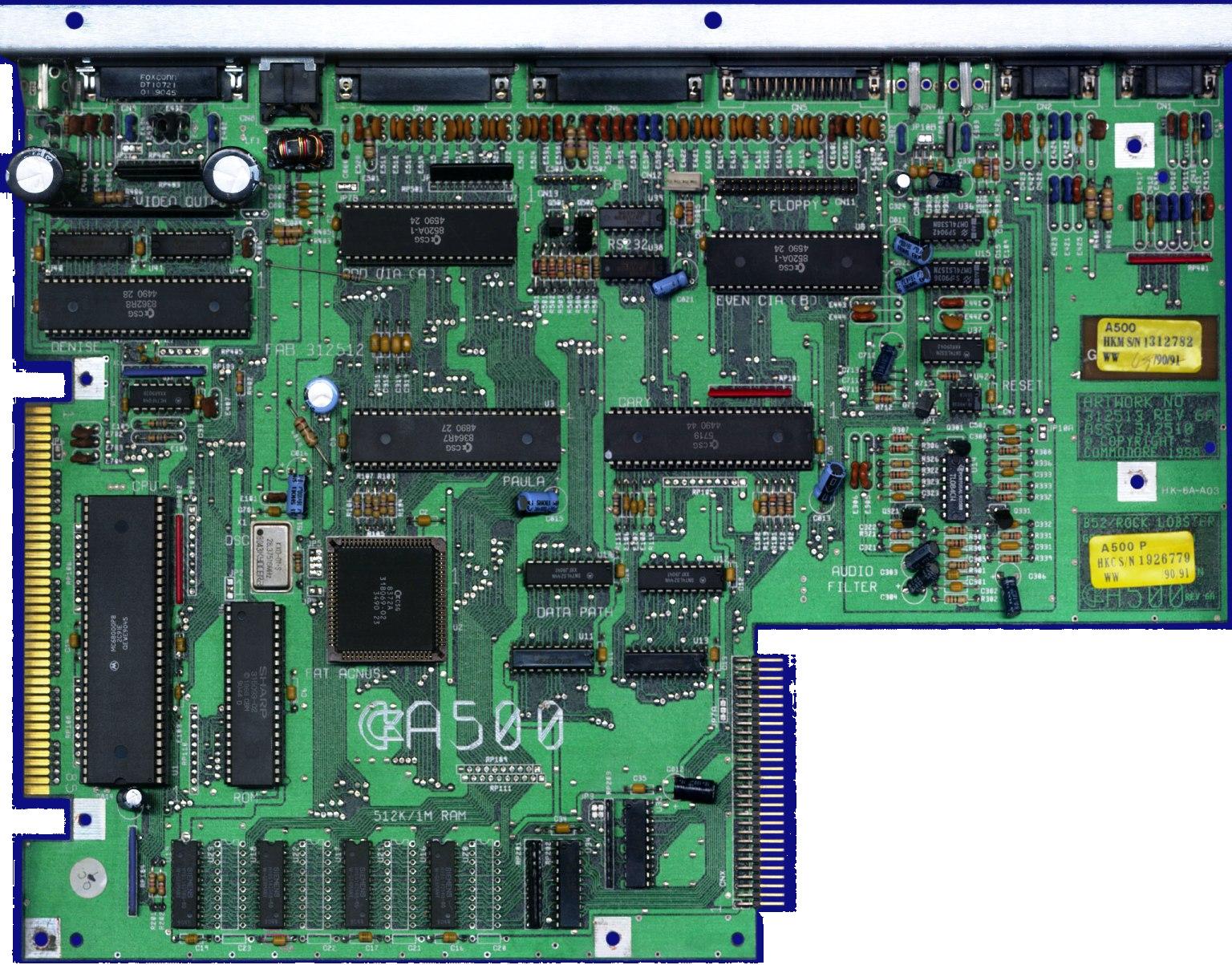
Component details reproduced with friendly permission from Sothius' Home, www.sothius.com (shame you closed your site, Sothius, it was great! Ed)
Hover your mouse over the circuit board for a description of the components

Component details reproduced with friendly permission from Sothius' Home, www.sothius.com
 Trivia
- the first Amiga, the A1000 was codenamed 'Lorraine'.
- the A500 and A500+ codename was B52/Rock Lobster, named after a song by the B52s.
- the codename of the A1200 during development was 'Amiga 800/900', later called 'Channel-Z' - again, named after a song from the B52s.
- the Amiga CD32 had several codenames: 'Spellbound', 'A100', 'Amiga CD/GAMES SYSTEM', and 'CD/GAME'.
- all A600s and A1200s have mountings for 2.5" hard disk drives internally.
- AGA (Advanced Graphics Architecture), known simply as "AA" during development, was intended to fill the gap between the technically old ECS (Enhanced Chip Set) and the long-planned AAA (Advanced Amiga Architecture) which was conceived way back in 1987. However, AAA never got past the prototype stage before Commodore went bankrupt. Available graphics capabilities are (in ascending order of ability): OCS, ECS, AGA.
- Earlier versions of the Amiga's operating system were referred to as AmigaDOS. The name was changed to AmigaOS from 3.1 onwards.
- The sound capabilities of the Amiga, while very good, were never able to provide the functionality of music maestros who instead chose the Atari ST. A DSP (Digital Signal Processor) was rumoured to be planned as an option for the A3000+ (the first AGA prototype). This used a modified A3000 board with support for AGA as well as a DSP, but the DSP was apparently dropped for cost reasons, and so Paula was once again used for the AGA machines.
- Kickstart 2.0 was the first to introduce the "boot menu", accessible by pressing both mouse buttons simultaneously at boot time. From this menu the user can enable/disable devices, choose a boot device, switch off CPU caches, switch from NTSC/PAL, and force OCS/ECS compatibility (AGA was added from Kick 3.0 onwards).
- some A1000s (those with the 'later board') had the Composite output that supported only monochrome.
- one expansion option was called 'Sidecar'. It turned the Amiga into a fully XT-compatible PC, and plugged into the side expansion slot. The Sidecar was basically a stripped-down Commodore PC-10 board and a 5.25" disk drive, sharing the Amiga monitor, mouse and keyboard.
- Apparently, newer Amiga 500 Revision 8 motherboards (with ECS graphics) can be identified by the logo that appears directly above the power and drive LEDs. If it reads A500 then it's a newer model. If it has the Commodore logo, it's an older model. The reason for this is that the newer A500 models were produced with the same motherboards as the A500+, which included the ECS chipset.