


Boulder Dash 2: Rockfords Riot (1985) 
| Details (Commodore 64) | Supported platforms | Artwork and Media | |
|---|---|---|---|
| Publisher: Genre: Author(s): Musician(s): Minimum Memory Required: Maximum Players: Joysticks: Language: Media Code: Media Type: Country of Release: Related Titles: Other Files: Comments: |  First Star Software Inc First Star Software IncArcade (Collect'em Up [Miscellaneous] Jeff Schneider, Peter Liepa Peter Liepa 64K 1 Yes Eng N/A Audio cassette UK (£9.95) Boulder Dash Boulder Dash 3 Game map, Game instructions | Click to choose platform: Commodore 64 Sinclair ZX Spectrum Amstrad CPC  |

| Videos | Screenshots (Commodore 64) |
|---|---|
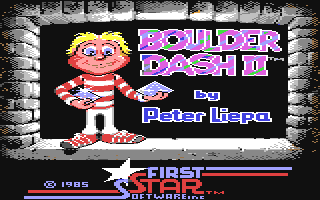  |
Please login to submit a screenshot
| Your Reviews |
|---|
 Issue 3, June 1985 (Zzap! 64) 17th Mar 2013 07:20
Boulder Dash II arrives with 16 new caves
Few new features, but the same great gameplay
Let's get the disappointment out of the way first. Rockford's Riot, the follow up to the amazing Boulder Dash, is not what it could have been.
It's not that it's worse than Boulder Dash, it's just that it doesn't really take Boulder Dash's brilliant originality any further. The graphics and sounds are the same, the enemies are the same, the game structure is the same, the objective is the same.
All that First Star have done is create 16 new caves, making Rockford's Riot very much a continuation of Boulder Dash, rather than a true sequel. This is a real pity in view of what might have been done. Having said that, the addictiveness and gameplay in Boulder Dash was so immense that even a straightforward follow on has got to leave most competitors stone dead -- and there's no question that Rockford's Riot will offer most people WEEKS of enjoyable play.
As before, the game puts you in the role of the Zzap margin megastar Rockford, who's trapped in a cave filled with dangerous toppling boulders, lethal fireflies, magic butterflies, enchanted walls, growing amoeba, and . . . diamonds. The idea is to collect a certain number of diamonds within a time limit (which varies from cave to cave and according to the difficulty level), and then escape through the cave exit to a new cave.
The special appeal is that although the game's riddled with puzzles, there's no single solution to each one. Different players will develop their own approach, and most caves needn't be played in the same way each time. What is more, to get anywhere you must exploit the behaviour of the various enemies. A firefly will explode if hit by a boulder, offering you a technique for blasting your way into otherwise inaccessible caverns. Butterflies, if lured into contact with the amoeba, will explode into jewels. Boulders can be used to seal yourself off from chasing enemies. And so on.
Each cave covers several screens of playing area, the picture scrolling smoothly to follow the action. There are 16 different caves, all presenting very different challenges, and five difficulty levels where the basic cave structures remain unaltered, but the position of individual items within them is different, creating new problems on each level.
As before, on the first three levels you can choose to start at cave A, E, I or M, which allows you to see a lot of the game before very long, rather than having to play all the way through from the start. However, levels 4 and 5 cannot be started part way through. This is an excellent game structure, offering enough early encouragement while holding out a long-term challenge.
The caves on Rockford's Riot include some superbly original new layouts. In general they present more complex tasks, with longer time limits allowed.
For example, on the very first cave you have to sneak past fireflies, then use one of them to blast an entry into a sealed off chamber, seal it again to keep out the enemies, clear out the space under an enchanted wall, set boulders cascading through it to turn them into diamonds, and then dash to the exit past any surviving fireflies.
But despite the extra complexities, it doesn't seem any harder overall -- indeed, experienced Boulder Dash players may be able to plough straight through level one at virtually the first attempt. The higher levels are another matter.
One very important point worth taking into account in judging the game is that Beyond, having taken over the rights from Statesoft, are putting Boulder Dash itself on the other side of the tape. This is a shrewd move.
So far Boulder Dash has sold surprisingly poorly, probably because buyers have been put off by the relatively uninspiring screenshots, and Statesoft's somewhat lacklustre advertising. But now, anyone who hasn't got the original can go ahead and buy this tape confident of getting stunning value for money. While people who already have the original probably won't need too much convincing to buy themselves another 16 caves!
Meanwhile, we at Zzap, including Rockford, are doing our best to convince Beyond and First Star to release a Boulder Dash III complete with a facility to design your own screens -- the lastability on that would be mind-boggling!
The new features
There are just two features in Rockford's Riot which didn't appear in Boulder Dash, and since at the time of writing, no instructions for the game exist in Britain, we're not sure quite what they're supposed to be. So we'll just describe them.
The first is a flat, blue expanse, a single-square thick, which appears in two caves. It cannot be passed through by Rockford, but diamonds and boulders will fall through it, after stopping on the surface for a random amount of time. This leads to some interesting and novel gameplay, in particular in cave M, where Rockford starts off underneath this blue layer, with huge piles of boulders and diamonds above.
The second new feature is a new kind of magic wall which appears only in cave O. You don't realise its special until you clear the earth away next to it. Crunch! It grows! We reckon this feature could have been put to a lot more use in other caves . . . Boulder Dash III, maybe . . . ?
The original features
Here's what you can expect to find in Rockford's Riot:
CAVE A: See main review.
CAVE B: An amoeba growing out of three walled off silos. Trap it (that's easy!), to turn it into dozens of diamonds, then unplug the silos at the bottom to reap a rich reward.
CAVE C: Work your way through a rock wall spiral, past scores of boulders and an awful lot of fireflies.
CAVE D: There's a stack of jewels on the right of the cave, but you can't reach them because a massive amoeba is blocking the way. So you have to blow your way through it by releasing hordes of fireflies. Great cave.
CAVE E: See 'The new features'.
CAVE F: First you must run a gauntlet of fireflies (easy once you've sussed the pattern) to reach two massive walled off containers packed with boulders and diamonds. Careful manoeuvring required to get all you need before rerunning the gauntlet back to the exit.
CAVE G: Once again, plenty of fireflies in evidence, but this time you have to use them to blow through a series of four separate walls before you can reach the exit.
CAVE H: Nice one, this. On one side a row of butterflies rushing round a square. On the other side a growing amoeba. The problem is how on earth to persuade the butterflies to break out of their square and go and hit the amoeba (where they explode into jewels).
CAVE I: A score of walls, each topped by a row of jewels and earth, and patrolled by fireflies. Grabbing the jewels -- you need almost every one -- is just a matter of sussing the fireflies' pattern. Not our favourite cave.
CAVE J: Has similarities to the amazing cave N in Boulder Dash. No jewels in sight. Just eight pairs of boulders, each sealing off a firefly and a butterfly. So how do you use the boulders to smash the butterflies without being hit by a firefly?
CAVE K: Guaranteed to get your pulse racing. Plenty of diamonds in easy enough positions to collect. Only trouble is you can't start without releasing a strong queue of fireflies who stay on your tail throughout -- there are no boulders to use against them.
CAVE L: Jewels hidden in stacks of boulders and packed into a network of 21 walled boxes -- boy is it easy to get trapped.
CAVE M: See 'new features'.
CAVE N: Entertaining screen, featuring jewels adjacent to a firefly patrolled passage, plus two open spaces teeming with the evil creatures. Plenty of scope for firefly bashing.
CAVE O: See 'new features'.
CAVE P: Classic screen, in which you have to extract the jewels from an absolute mountain of boulders. Very tricky indeed.
PRESENTATION
85% Good packaging, options and game structure.
ORIGINALITY
30% Too close to Boulderdash for comfort.
GRAPHICS
71% Same as before, a bit crude but functional.
HOOKABILITY
85% Totally absorbing, unless you've had your fill of Boulderdash.
SOUND
59% Tinkling of gems, rumbling of boulders, explosions and amoeba.
LASTABILITY
84% 16 very different multi-screen caves, and five difficulty levels.
VALUE FOR MONEY
82% If you haven't got Boulderdash the VFM is out of this world.
Few new features, but the same great gameplay
Let's get the disappointment out of the way first. Rockford's Riot, the follow up to the amazing Boulder Dash, is not what it could have been.
It's not that it's worse than Boulder Dash, it's just that it doesn't really take Boulder Dash's brilliant originality any further. The graphics and sounds are the same, the enemies are the same, the game structure is the same, the objective is the same.
All that First Star have done is create 16 new caves, making Rockford's Riot very much a continuation of Boulder Dash, rather than a true sequel. This is a real pity in view of what might have been done. Having said that, the addictiveness and gameplay in Boulder Dash was so immense that even a straightforward follow on has got to leave most competitors stone dead -- and there's no question that Rockford's Riot will offer most people WEEKS of enjoyable play.
As before, the game puts you in the role of the Zzap margin megastar Rockford, who's trapped in a cave filled with dangerous toppling boulders, lethal fireflies, magic butterflies, enchanted walls, growing amoeba, and . . . diamonds. The idea is to collect a certain number of diamonds within a time limit (which varies from cave to cave and according to the difficulty level), and then escape through the cave exit to a new cave.
The special appeal is that although the game's riddled with puzzles, there's no single solution to each one. Different players will develop their own approach, and most caves needn't be played in the same way each time. What is more, to get anywhere you must exploit the behaviour of the various enemies. A firefly will explode if hit by a boulder, offering you a technique for blasting your way into otherwise inaccessible caverns. Butterflies, if lured into contact with the amoeba, will explode into jewels. Boulders can be used to seal yourself off from chasing enemies. And so on.
Each cave covers several screens of playing area, the picture scrolling smoothly to follow the action. There are 16 different caves, all presenting very different challenges, and five difficulty levels where the basic cave structures remain unaltered, but the position of individual items within them is different, creating new problems on each level.
As before, on the first three levels you can choose to start at cave A, E, I or M, which allows you to see a lot of the game before very long, rather than having to play all the way through from the start. However, levels 4 and 5 cannot be started part way through. This is an excellent game structure, offering enough early encouragement while holding out a long-term challenge.
The caves on Rockford's Riot include some superbly original new layouts. In general they present more complex tasks, with longer time limits allowed.
For example, on the very first cave you have to sneak past fireflies, then use one of them to blast an entry into a sealed off chamber, seal it again to keep out the enemies, clear out the space under an enchanted wall, set boulders cascading through it to turn them into diamonds, and then dash to the exit past any surviving fireflies.
But despite the extra complexities, it doesn't seem any harder overall -- indeed, experienced Boulder Dash players may be able to plough straight through level one at virtually the first attempt. The higher levels are another matter.
One very important point worth taking into account in judging the game is that Beyond, having taken over the rights from Statesoft, are putting Boulder Dash itself on the other side of the tape. This is a shrewd move.
So far Boulder Dash has sold surprisingly poorly, probably because buyers have been put off by the relatively uninspiring screenshots, and Statesoft's somewhat lacklustre advertising. But now, anyone who hasn't got the original can go ahead and buy this tape confident of getting stunning value for money. While people who already have the original probably won't need too much convincing to buy themselves another 16 caves!
Meanwhile, we at Zzap, including Rockford, are doing our best to convince Beyond and First Star to release a Boulder Dash III complete with a facility to design your own screens -- the lastability on that would be mind-boggling!
The new features
There are just two features in Rockford's Riot which didn't appear in Boulder Dash, and since at the time of writing, no instructions for the game exist in Britain, we're not sure quite what they're supposed to be. So we'll just describe them.
The first is a flat, blue expanse, a single-square thick, which appears in two caves. It cannot be passed through by Rockford, but diamonds and boulders will fall through it, after stopping on the surface for a random amount of time. This leads to some interesting and novel gameplay, in particular in cave M, where Rockford starts off underneath this blue layer, with huge piles of boulders and diamonds above.
The second new feature is a new kind of magic wall which appears only in cave O. You don't realise its special until you clear the earth away next to it. Crunch! It grows! We reckon this feature could have been put to a lot more use in other caves . . . Boulder Dash III, maybe . . . ?
The original features
Here's what you can expect to find in Rockford's Riot:
CAVE A: See main review.
CAVE B: An amoeba growing out of three walled off silos. Trap it (that's easy!), to turn it into dozens of diamonds, then unplug the silos at the bottom to reap a rich reward.
CAVE C: Work your way through a rock wall spiral, past scores of boulders and an awful lot of fireflies.
CAVE D: There's a stack of jewels on the right of the cave, but you can't reach them because a massive amoeba is blocking the way. So you have to blow your way through it by releasing hordes of fireflies. Great cave.
CAVE E: See 'The new features'.
CAVE F: First you must run a gauntlet of fireflies (easy once you've sussed the pattern) to reach two massive walled off containers packed with boulders and diamonds. Careful manoeuvring required to get all you need before rerunning the gauntlet back to the exit.
CAVE G: Once again, plenty of fireflies in evidence, but this time you have to use them to blow through a series of four separate walls before you can reach the exit.
CAVE H: Nice one, this. On one side a row of butterflies rushing round a square. On the other side a growing amoeba. The problem is how on earth to persuade the butterflies to break out of their square and go and hit the amoeba (where they explode into jewels).
CAVE I: A score of walls, each topped by a row of jewels and earth, and patrolled by fireflies. Grabbing the jewels -- you need almost every one -- is just a matter of sussing the fireflies' pattern. Not our favourite cave.
CAVE J: Has similarities to the amazing cave N in Boulder Dash. No jewels in sight. Just eight pairs of boulders, each sealing off a firefly and a butterfly. So how do you use the boulders to smash the butterflies without being hit by a firefly?
CAVE K: Guaranteed to get your pulse racing. Plenty of diamonds in easy enough positions to collect. Only trouble is you can't start without releasing a strong queue of fireflies who stay on your tail throughout -- there are no boulders to use against them.
CAVE L: Jewels hidden in stacks of boulders and packed into a network of 21 walled boxes -- boy is it easy to get trapped.
CAVE M: See 'new features'.
CAVE N: Entertaining screen, featuring jewels adjacent to a firefly patrolled passage, plus two open spaces teeming with the evil creatures. Plenty of scope for firefly bashing.
CAVE O: See 'new features'.
CAVE P: Classic screen, in which you have to extract the jewels from an absolute mountain of boulders. Very tricky indeed.
PRESENTATION
85% Good packaging, options and game structure.
ORIGINALITY
30% Too close to Boulderdash for comfort.
GRAPHICS
71% Same as before, a bit crude but functional.
HOOKABILITY
85% Totally absorbing, unless you've had your fill of Boulderdash.
SOUND
59% Tinkling of gems, rumbling of boulders, explosions and amoeba.
LASTABILITY
84% 16 very different multi-screen caves, and five difficulty levels.
VALUE FOR MONEY
82% If you haven't got Boulderdash the VFM is out of this world.
| Cheats | Trivia |
|---|---|
| There are no cheats on file for this title. | No trivia on file for this title. |
History
This title was first added on 9th May 2013
This title was most recently updated on 16th September 2016