


Knight Games (1986) 
| Details (Commodore 64) | Supported platforms | Artwork and Media | |
|---|---|---|---|
| Publisher: Genre: Author(s): Minimum Memory Required: Maximum Players: Joysticks: Language: Media Code: Media Type: Country of Release: Related Titles: Comments: |  English Software English SoftwareFighting Jon Williams 64K 1 Yes, required Eng N/A Audio cassette UK (£9.95) Knight Games 2 - Space Trilogy (I II & III) | Click to choose platform: Amstrad CPC Commodore 64  |
| Videos | Screenshots (Commodore 64) |
|---|---|
| (no videos on file) | 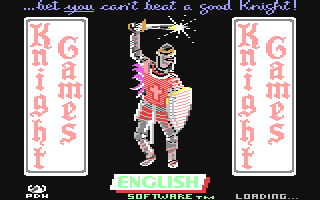 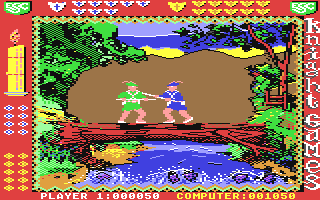 |
Please login to submit a screenshot
| Your Reviews |
|---|
 jup (Unknown) 23rd Mar 2013 10:16
"What kind of fighting games were around before Street Fighter? Rather boring, non-combo moving and close combat ones. That's what."
''...bet you can't beat a good Knight!'' is what this game challenges you to as it first boots up. This game was made by English Software and was probably inspired by all the EPYX Olympic-style Game releases. While there are eight different game types in Knight Games, six of them are one-on-one combat related. Unless you have another player to compete against, the computer will substitute. And, it is usually a pretty hard opponent to beat...especially when you set the difficulty to Knight.
After booting, you are presented with a graphical screen with eight choices. The joystick will move the game show style box to the game icon of your choice. Each icon looks like a man either in armor or some sort of Robin Hood style clothes. The top four games reside on side one of the disk. And, the bottom four reside on side 2. The good news is that once you load one of the eight games, it stays in the Commodore's memory until you select another game. Which means that repeating the same game over and over will save you some loading time. It also means that the game will demo that one (and only that one) game for as long as you do not select another.
For games, there are:
+ Sword Fight 1 (Both characters are dressed up in suits of armor and carry both a shield and a sword. They stand in the courtyard of a castle with a white flag with a red cross waiving in the background. There is a lot of atmosphere to look at. But, much of it is done in an old school coloring way, where two rather large pixels of color checkerboard each other. While it does work, there are very likely no video games that would even think of doing such a thing, these days. The idea seems to be as basic as to hack and slash your opponent with the sword until they lose all their strength and drop to their knees. Each character has two different strength meters. One is shown on the left for both characters. (Looks like discs of some sort in two colors.) As each character takes on damage, these columns of discs slowly disappear. Once they are gone, either another set will appear (Taken from the other meter.) or the character will drop. Then, there is the meter at the top of the screen for both characters. (Looks like a shield of two different colors.) This is like the overall reserve strength of both characters. Once those disc bars disappear, one of these will go to replenish that other meter. Once all of the shield meters and the discs are gone, the player has lost. (Death is probably not a result, though.) It's the strength on these meters and not the amount of times a character is dropped to their knees that counts. Each hit seems to add up so many points that are tallied at the bottom of the screen. Another way of winning the match is to have more strength than your opponent by the time the match timer runs out. (Which is done in a very nice and graphically fitting way...a candle that slowly burns as time moves on. The candle's wax slowly drips as the candle disappears. Matches can be set to last four, six or up to eight minutes.) The combat commences in a 2-D fashion, like most of the early one-on-on combat games did. You can advance and retreat a little. But, the rest of the joystick movements do various body movements that involve the shield and sword. While there is some strategy involved in using the correct counter-move to an attack and striking at your opponent's weak spot during a move, the overall concept is generally mindless combat until someone drops. The background music that plays is pretty well done. (As is the case with all the games and the menu screens.))
+ Sword Fight 2 (Just like the name implies, Sword Fight 2 is very similar to Sword Fight 1. It appears that all the moves that can be performed remain the same. Which pretty much leaves the background music, background visuals and suits of armor. The BG music is different and still very good. The visuals are now with the castle and town in the background with the Knights sword fighting on the grassy plains in front of it. They are also wearing a different suit of armor. Everything else is explained in Sword Fight 1.)
+ Quarter Staff (While all the moves are different, the same general idea is there. Two guys dressed in something out of Robin Hood keep kicking and whacking at each other with long staffs on a log that crosses a raging stream. The music is unique to the stage and is well done. The atmosphere around the two fighters is very colorful and gives a great sense of where you are. But, unlike the two sword fights, it is completely stagnant. Which is exactly what the ''raging stream'' shouldn't be. Oh, well. And, instead of taking your opponent to his knees, you try to knock him on his butt.)
+ Pike Staff (A couple Knights dressed in armor attack at each other with a staff that has a sort of hook and point on it. Each move uses that staff in a different way. Music is very good. Graphics are as colorful as all the other scenes. The Knights are fighting far away from the castle. (It's way in the background.) Not too much more to say.)
+ Archery (If you want to take a break from all the one-on-one fighting games, this is one of the two available alternatives. The idea is that you are an archer, shooting arrows with a bow at these distant metal horses on wheels. To aim, you place your cross hair sight somewhere in front of a metal horse and release your arrow. It will fly through the air, finding your sight mark almost two seconds later. If you hit the metal horse, you will hear a ting. Else, it will sound more like a plop. Forget about trying to aim at anything else than the metal horses pulled by a cable. Your sights won't be permitted to wander. (Although, it might have been really fun if they had and provided other targets.) Now, just aiming your sight is too easy. Which is why it simulates the unsteady hands of the archer character. Meaning, that cross hair will bounce around all over the place. Most of the screen is reserved for the stagnant atmosphere. Except for one little flag waving in the wind. The health meters are used to count how many arrows you have left. And, the point of the difficulty levels seems to make very little difference in this game. As far as I can tell, it only alters the total amount of time you are allowed in the session. It may also affect the steadiness of your sight a little, too. It's a guessing game if it is worth shooting as many arrows as you can or saving them. As you do get points for each arrow saved. But, landing a successful hit on a horse is worth more. You probably will never use up your entire stash of arrows, no matter how much time you choose to compete in.)
+ Crossbow (Crossbow has a very similar theme to Archery. Only, the targets are not metal horses, but two metal discs and a metal cross. And, instead of being moved at a constant rate of speed across the screen to the left, they stay in one spot and rotate on a timely basis. Your character is using a crossbow instead of a bow, this time. But, it does not help your shaky sights one bit. And, as before, you can't take aim at anything outside the three rotating targets area. Each target is worth a different amount of points, when you hit its face side.)
+ Ball & Chain (Back to the one-on-one combat scene. This time, there are two Knights fighting on the draw bridge over the moat of the castle with a ball & chain in one hand and a shield in the other. Each character wears a suit of armor. While the music is well done, most of it gets lost amongst the constant clanging of the spiked balls.)
+ Axe Man (This time, it appears to be two Axe wielding Knights in the throne room of the castle, as there are lots of treasures and such sitting around. And, as in Ball & Chain, the music loses out greatly to the sound effects.)
While there is a total of eight Knight Games available, what would really have been nice is if there were more variety in the kinds of games. Sure. Two or three different one-on-one fighting games would be nice. But, did we really need six? How about a Joust, or something?
What seems to pull the eight games together is the scores that you earn in each one. (There is a top score screen that tallies them up into a grand score for the two players. (Even if one is the computer. And, you can outscore it, as it does not get a chance to score in the two shooting games.)
Graphics: 7 out of 10.
While each game uses a wide variety of colors and visuals, it is almost always stagnant. Except for the occasional single waving flag, there is nothing that moves outside of the characters or the targets. Plus, many of the colors use an outdated look of dual, large pixels in a checkered pattern. Which is something that even many Commodore games didn't do by 1986. And, every game has zero scrolling capacity. What you see is what you get and nothing more. But, what is there is usually good eye candy. Just don't expect to interact with any of it.
Sound: 7 out of 10.
The music remains great throughout all the games, and is quite different for each one. The only problem is that any time a sound effect is called, it robs the music of that SID channel it was using. And, seeing as how most of the games are combat and require constant walking, banging, clanging sound effects, a lot of that game music will be cut down by two-thirds at most times. At least, all the games offer the option to turn the BG music on or off. All the games have a few sound effects. But, it pretty much comes down to steps, swings and weapon clashes. (Or arrow movements and hits or misses in the archery-type games.)
Controls: 10 out of 10.
The controls are easy to learn and remain constant and responsive in the two different genes that are really available. In the two archery games, the joystick moves the cross hairs and the button fires (When the arrow is ready.) And, in the six one-on-one fighting games, each primary joystick direction makes an attack move of some sort. (Just don't expect to be pulling off any fancy attacks by tapping left-left-right-up-button, or such.) The game doesn't really get much deeper than that.
Overall: 7 out of 10.
For fans of all those one-on-one fighting games, this classic might be worth checking out. It's good for both a one and two player game. But, if not, there is nothing more than a couple archery-type games in the stack. All in all, this is something like six little Street Fighter-type games and two Point Blank-type games stuck together inside one disk. If you don't like either of those genes, avoid this game. Otherwise, find it, if you can. Just don't pay a King's ransom for it.
Reviewer's Score: 7/10 | Originally Posted: 03/13/02, Updated 03/13/02
''...bet you can't beat a good Knight!'' is what this game challenges you to as it first boots up. This game was made by English Software and was probably inspired by all the EPYX Olympic-style Game releases. While there are eight different game types in Knight Games, six of them are one-on-one combat related. Unless you have another player to compete against, the computer will substitute. And, it is usually a pretty hard opponent to beat...especially when you set the difficulty to Knight.
After booting, you are presented with a graphical screen with eight choices. The joystick will move the game show style box to the game icon of your choice. Each icon looks like a man either in armor or some sort of Robin Hood style clothes. The top four games reside on side one of the disk. And, the bottom four reside on side 2. The good news is that once you load one of the eight games, it stays in the Commodore's memory until you select another game. Which means that repeating the same game over and over will save you some loading time. It also means that the game will demo that one (and only that one) game for as long as you do not select another.
For games, there are:
+ Sword Fight 1 (Both characters are dressed up in suits of armor and carry both a shield and a sword. They stand in the courtyard of a castle with a white flag with a red cross waiving in the background. There is a lot of atmosphere to look at. But, much of it is done in an old school coloring way, where two rather large pixels of color checkerboard each other. While it does work, there are very likely no video games that would even think of doing such a thing, these days. The idea seems to be as basic as to hack and slash your opponent with the sword until they lose all their strength and drop to their knees. Each character has two different strength meters. One is shown on the left for both characters. (Looks like discs of some sort in two colors.) As each character takes on damage, these columns of discs slowly disappear. Once they are gone, either another set will appear (Taken from the other meter.) or the character will drop. Then, there is the meter at the top of the screen for both characters. (Looks like a shield of two different colors.) This is like the overall reserve strength of both characters. Once those disc bars disappear, one of these will go to replenish that other meter. Once all of the shield meters and the discs are gone, the player has lost. (Death is probably not a result, though.) It's the strength on these meters and not the amount of times a character is dropped to their knees that counts. Each hit seems to add up so many points that are tallied at the bottom of the screen. Another way of winning the match is to have more strength than your opponent by the time the match timer runs out. (Which is done in a very nice and graphically fitting way...a candle that slowly burns as time moves on. The candle's wax slowly drips as the candle disappears. Matches can be set to last four, six or up to eight minutes.) The combat commences in a 2-D fashion, like most of the early one-on-on combat games did. You can advance and retreat a little. But, the rest of the joystick movements do various body movements that involve the shield and sword. While there is some strategy involved in using the correct counter-move to an attack and striking at your opponent's weak spot during a move, the overall concept is generally mindless combat until someone drops. The background music that plays is pretty well done. (As is the case with all the games and the menu screens.))
+ Sword Fight 2 (Just like the name implies, Sword Fight 2 is very similar to Sword Fight 1. It appears that all the moves that can be performed remain the same. Which pretty much leaves the background music, background visuals and suits of armor. The BG music is different and still very good. The visuals are now with the castle and town in the background with the Knights sword fighting on the grassy plains in front of it. They are also wearing a different suit of armor. Everything else is explained in Sword Fight 1.)
+ Quarter Staff (While all the moves are different, the same general idea is there. Two guys dressed in something out of Robin Hood keep kicking and whacking at each other with long staffs on a log that crosses a raging stream. The music is unique to the stage and is well done. The atmosphere around the two fighters is very colorful and gives a great sense of where you are. But, unlike the two sword fights, it is completely stagnant. Which is exactly what the ''raging stream'' shouldn't be. Oh, well. And, instead of taking your opponent to his knees, you try to knock him on his butt.)
+ Pike Staff (A couple Knights dressed in armor attack at each other with a staff that has a sort of hook and point on it. Each move uses that staff in a different way. Music is very good. Graphics are as colorful as all the other scenes. The Knights are fighting far away from the castle. (It's way in the background.) Not too much more to say.)
+ Archery (If you want to take a break from all the one-on-one fighting games, this is one of the two available alternatives. The idea is that you are an archer, shooting arrows with a bow at these distant metal horses on wheels. To aim, you place your cross hair sight somewhere in front of a metal horse and release your arrow. It will fly through the air, finding your sight mark almost two seconds later. If you hit the metal horse, you will hear a ting. Else, it will sound more like a plop. Forget about trying to aim at anything else than the metal horses pulled by a cable. Your sights won't be permitted to wander. (Although, it might have been really fun if they had and provided other targets.) Now, just aiming your sight is too easy. Which is why it simulates the unsteady hands of the archer character. Meaning, that cross hair will bounce around all over the place. Most of the screen is reserved for the stagnant atmosphere. Except for one little flag waving in the wind. The health meters are used to count how many arrows you have left. And, the point of the difficulty levels seems to make very little difference in this game. As far as I can tell, it only alters the total amount of time you are allowed in the session. It may also affect the steadiness of your sight a little, too. It's a guessing game if it is worth shooting as many arrows as you can or saving them. As you do get points for each arrow saved. But, landing a successful hit on a horse is worth more. You probably will never use up your entire stash of arrows, no matter how much time you choose to compete in.)
+ Crossbow (Crossbow has a very similar theme to Archery. Only, the targets are not metal horses, but two metal discs and a metal cross. And, instead of being moved at a constant rate of speed across the screen to the left, they stay in one spot and rotate on a timely basis. Your character is using a crossbow instead of a bow, this time. But, it does not help your shaky sights one bit. And, as before, you can't take aim at anything outside the three rotating targets area. Each target is worth a different amount of points, when you hit its face side.)
+ Ball & Chain (Back to the one-on-one combat scene. This time, there are two Knights fighting on the draw bridge over the moat of the castle with a ball & chain in one hand and a shield in the other. Each character wears a suit of armor. While the music is well done, most of it gets lost amongst the constant clanging of the spiked balls.)
+ Axe Man (This time, it appears to be two Axe wielding Knights in the throne room of the castle, as there are lots of treasures and such sitting around. And, as in Ball & Chain, the music loses out greatly to the sound effects.)
While there is a total of eight Knight Games available, what would really have been nice is if there were more variety in the kinds of games. Sure. Two or three different one-on-one fighting games would be nice. But, did we really need six? How about a Joust, or something?
What seems to pull the eight games together is the scores that you earn in each one. (There is a top score screen that tallies them up into a grand score for the two players. (Even if one is the computer. And, you can outscore it, as it does not get a chance to score in the two shooting games.)
Graphics: 7 out of 10.
While each game uses a wide variety of colors and visuals, it is almost always stagnant. Except for the occasional single waving flag, there is nothing that moves outside of the characters or the targets. Plus, many of the colors use an outdated look of dual, large pixels in a checkered pattern. Which is something that even many Commodore games didn't do by 1986. And, every game has zero scrolling capacity. What you see is what you get and nothing more. But, what is there is usually good eye candy. Just don't expect to interact with any of it.
Sound: 7 out of 10.
The music remains great throughout all the games, and is quite different for each one. The only problem is that any time a sound effect is called, it robs the music of that SID channel it was using. And, seeing as how most of the games are combat and require constant walking, banging, clanging sound effects, a lot of that game music will be cut down by two-thirds at most times. At least, all the games offer the option to turn the BG music on or off. All the games have a few sound effects. But, it pretty much comes down to steps, swings and weapon clashes. (Or arrow movements and hits or misses in the archery-type games.)
Controls: 10 out of 10.
The controls are easy to learn and remain constant and responsive in the two different genes that are really available. In the two archery games, the joystick moves the cross hairs and the button fires (When the arrow is ready.) And, in the six one-on-one fighting games, each primary joystick direction makes an attack move of some sort. (Just don't expect to be pulling off any fancy attacks by tapping left-left-right-up-button, or such.) The game doesn't really get much deeper than that.
Overall: 7 out of 10.
For fans of all those one-on-one fighting games, this classic might be worth checking out. It's good for both a one and two player game. But, if not, there is nothing more than a couple archery-type games in the stack. All in all, this is something like six little Street Fighter-type games and two Point Blank-type games stuck together inside one disk. If you don't like either of those genes, avoid this game. Otherwise, find it, if you can. Just don't pay a King's ransom for it.
Reviewer's Score: 7/10 | Originally Posted: 03/13/02, Updated 03/13/02
Issue 17, August 1986 (Zzap! 64) 19th Mar 2013 05:17| Cheats | Trivia |
|---|---|
| There are no cheats on file for this title. | No trivia on file for this title. |
History
This title was first added on 5th December 2012
This title was most recently updated on 23rd March 2013