


Ogre Battle 64: Person of Lordly Caliber (1999) 
| Details (Nintendo 64) | Supported platforms | Artwork and Media | |
|---|---|---|---|
| Publisher: Genre: Author(s): Maximum Players: Joysticks: Language: Media Code: Media Type: Country of Release: Comments: |  Nintendo NintendoStrategy Quest 1 NUS-005 Nintendo 64 controller Eng NUS-NOBE Cartridge USA, Japan ELSPA Rating: T/- | Nintendo 64 |
| Videos | Screenshots (Nintendo 64) |
|---|---|
| (no videos on file) | 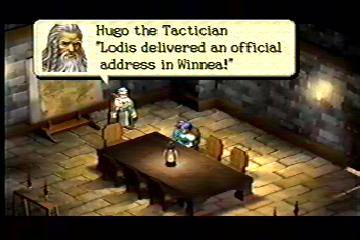 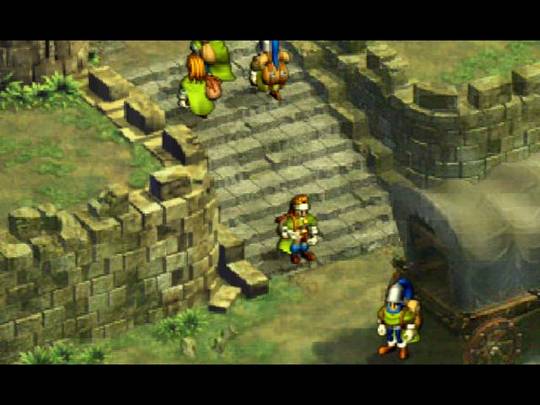 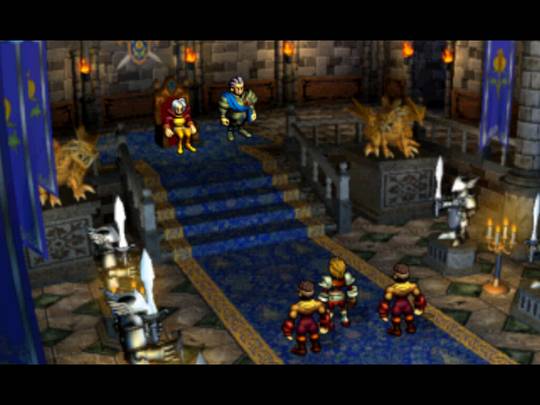 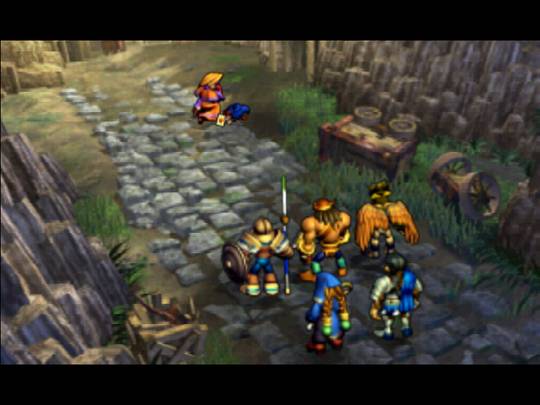 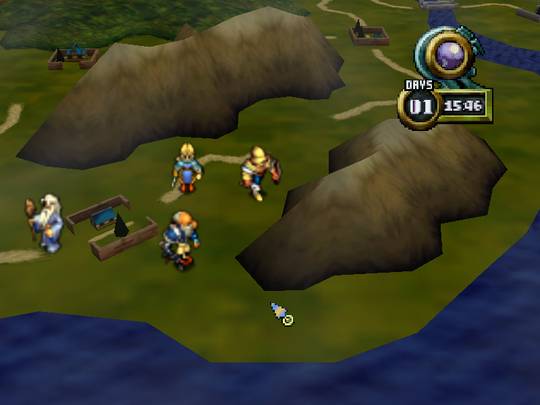 |
Please login to submit a screenshot
| Your Reviews |
|---|
 (Anonymous) (Unknown) 3rd Jun 2012 03:48
"The game that started me on a long line of strategy RPGs."
When I first rented this game, I wasn't really sure what to expect. I knew well enough what a strategy RPG was just from its name and from screenshots of other games, but how it would work I didn't really know. I tried it out, and it seemed pretty fun. The combat was simple enough and the game showed some promise. But, I later returned it, and that was the end of that...or so I thought. Flash forward a couple years. The game has been seriously catching my eye every time I go to Blockbuster. There it sits, gazing back at me with all of the other ancient N64 games. I keep wondering why they keep the damn thing and don't just sell it. A week later, I come back, and it's gone. Feeling angry and betrayed that Blockbuster would just throw it out, I boycotted the store for a couple weeks. Finally, when I bring myself to go back, it is sitting there in the preowned section for 10 bucks. So, now that I was the proud owner of it, I was able to finally play through the thing.
First off, I want to address the game's technical aspects. If you look at the 3d environments, they look fairly weak. The mountains and castles are pretty blocky. There's an interesting zoom in feature to let your characters appear more proportional to the things, but the stuff is still ugly. For that, I am slightly disappointed. However, after 5 minutes of cut-scenes and battles anything I thought about the game being ugly melted away. Everything else about it is simply gorgeous.
The characters are all very large for 2d characters, and are hand-drawn. Thus, they all look very detailed, and flow very fluently when moving or attacking. Along with that, all of the battles and cut-scenes are from isometric views. This means that: a) in battle, you will always be able to see all of the characters, and you will be able to see as much of them as possible. And b) The cut-scenes will always have a large, beautiful background, often painted, and which will usually start scrolling up at the end of a cut-scene to let us see all of it. Finally, the special effects are a marvel of 2d graphics. All of these combined make Ogre Battle 64 a contender with Golden Sun for the best 2d graphics ever in a game.
Story is rather hard to say. It starts out like 99% of every other RPG. ''Country A fights with Rebels'', ''Country B fights with Country C''. ''Main character starts off as part of something evil and joins the rebels'', blah blah blah. Most of the game is your typical political story-line, loaded with the obligatory lower and middle class oppression, greed, and usurpers of the throne finding out they themselves were being used, etc. It would get a relative low score were it not for the very strong main characters, cut-scenes, and the supernatural stuff and great plot revelations that start to occur in the later in the game.
Your character, Magnus, starts off as a warrior in the Central division of an army. You are given orders for some minor missions, when you are then asked to accompany the prince on an escort mission. The prince, Yumil, you discover is a childhood friend, whom Magnus left to train to become a warrior. After thwarting an assassination attempt, one of Yumil's bodyguards proceeds to execute the assassin. Magnus tries to stop him, the assassin is rescued by the Revolutionary army, and you all escape. Magnus decides to join the army, being the idealistic bum the main characters always are, and the game then proceeds with fighting the Divisions, as well as Lodis. Often the story can get rather confusing on who you're fighting, and then they have to throw in some crap with the Eastern Orthodox Church so we can have some religious references.
As I said, the cut-scenes and the main characters really pull the game along. Because of the game's often-tedious manner during missions, they provide alot of relief (the later story does as well, but I don't want to spoil any big plot-twists). The scenes manage to make a very entertaining and well-done sequence, despite being from isometric view. Though there are the occasional little irritating things (like the Final Fantasy style ''pull sword seemingly out of my leg'' syndrome), for the most part they are able to keep serious and have interesting fights without looking corny. I can guarantee Rhade kicking the crap out of the assassin looks 10 times more realistic than SD Kefka kicking someone's corpse. Magnus, though a little too ''Let's conquer an entire portion of the world without killing anyone'', remains a very cool character. Yumil, though a wimp at first, is very deep, and later becomes very important to the story. The rest of the characters all have their ups and downs, but manage to at least be two-dimensional characters.
The missions consist mainly of crossing one map to reach a castle at the other end. Since your characters get tired, they often must either camp out, or stop at towns. The real purpose of them is to be liberated, but often you'll want to get these hour long missions over with as soon as possible, so skipping a few doesn't hurt. Usually every town (unless it is neutral) will have an enemy guarding it. As soon as one of your characters touches his, a battle starts.
In a battle, your teams take turns attacking each other. I should point out that you don't actually control your team. You can only give them commands on how to attack (i.e. ''Attack strongest'', ''Attack Leader''). Once the teams have had their two turns, the battle is over. The winner is tallied up by damage points inflicted. The winner, unless obliterated, is knocked back a few feet. If the leader is killed, the group will wonder around aimlessly, not knowing what to do. Being attacked from an angle other than straight forward will alter the group. If they are attacked from the left, units that were on the left column will now be in the front row, etc. While this may always seem bad (and it usually is), some units have abilities that can only be done in the back or front rows. So, if you've managed to get some versatile units, who knows? Maybe those knights that got thrown in the back can use magic now!
The real ''strategy'' comes from how you develop your team. The game contains tons of classes, all having different uses. The only essential thing is that to get a unit you first need to have a soldier in your team. Once he grows up, he can be turned into whatever his class whose prerequisites he meets. Also, soldiers in a group headed by a male leader will become a fighter, while soldiers headed by a female leader will become an amazon. Along with stats and sex, there is also alignment. Alignment comes from your characters spiritual balance. If they are evil, their alignment is chaotic. If they are good, their alignment is lawful. Almost every class requires you to keep a balance of the two. Alot want one dominant over the other. So, it's up to you to not only balance the character's alignment, but the team's alignment as well. If a team contains nothing but lawful classes, the unit will become lawful. But, if it contains half lawful and half chaotic, it will eventually reach equilibrium at neutral. Battling itself depends on simply your units and their formation. Decide which units you want in the team, make them, and then decide how to place them. It follows common sense, like obviously putting archers and mages in the back, and strong guys in the front.
The game can be either very fun or very frustrating. It's very fun in all of the customization you can do, and watching your characters grow and how they battle. However, when you fight an enemy unit with a new guy that ends up dishing out huge damage and killing your leader, then it becomes very frustrating. The game itself is very hard, so it's not uncommon to find yourself having to completely restart a mission.
If the game truly shines in one area, it's the huge sense that you really are controlling an army. Your units can be dispatched at a headquarters and can be traded with each other, you end up buying sets of equipment to give your soldiers right before going into battle, neutral characters and enemies can be persuaded to join your team... All of this is creates a great sense of atmosphere. Maybe I'm just a sucker for the job system in RPGs, but I really had alot of fun with this.
What adds a whole lot to it is also the amount of polish in the maps. Almost every area like the forests, or the mountains, contains random monsters that you can find upon exploring it. Towns you visit have people you can talk to, some only on special days or that have errands for you to do. You often find yourself going on large miniquests just to get one character class or one piece of equipment. Near the end a real gem of the game is creating your ''ultimate team'', and watching it pave through armies of soldiers.
The soundtrack is another great point of the game. I really didn't expect much here, but man did it blow me away. The tunes all have a wide variety of types, going from the usual army and battle music to depressing tunes, town themes, and surprise music, all of which sounding almost orchestrated and very good.
Finally, the game is very long. It will take the average gamer between 40-60 hours to get through it (40 if you turn off battle animations, the latter if you don't). Ogre Battle winds up extremely epic. But, there are plenty of reasons to play through it again. There are roughly 6 different endings you can get by playing through the game, all of which depending on the decisions you make throughout the missions. Then there also around 40 special characters you can recruit depending on what you do in the mission. Sometimes you'll have to sacrifice the opportunity to get up to 3 units in order to get one really cool one. The maps also have some nonlinearity to them, so the story will change depending on which ones you do first, or even ones which you do period. The story may even change depending on whether or not a character left your party!
But that's not to say that the game is without fault. There are a few glaring problems that prevent the game from getting a 10 in my book. First of all, the game is frickin, hard! Even after spending a fortune training my guys to get them strong, they will still often fall. Sometimes you think everything is under control under one mysterious unit shows up that suddenly petrifies everyone, or wipes out half of your party! But that is forgivable. Strategy RPGs are never easy. The big thing is actually very small, but can wind up ruining your whole game. When characters first began entering cities, they captured them, and moved on. But soon after actually reading the text they say when they capture one, I noticed something very important. The units actually have two options on how they can take over a city. They can capture it, and they can liberate it. This depends on your units' alignment and how it compares with the morale of the town. Now, unfortunately, this is not something you will notice until late in the game, when in fact it is extremely important. If you mostly captured towns and were rarely able to liberate, you get the bad ending. Normally, this wouldn't be too bad, but when I say, ''bad ending'', I don't mean ''Over but doesn't feel complete'' ending. I mean ''I put 40 hours in the game for this!?!'' ending. Last, though a minor thing, your 3 main characters go through several class changes throughout the game. If you don't know this, however, you'll build them up heavily, because most likely they'll be your strongest units. So, when they level up, they'll wind up much weaker than if you had waited and not used them until after the class changes.
Overall, this is still an amazing game. While it starts off feeling fun, but average, it winds up becoming more fulfilling and epic. At its peak it got me hooked into strategy RPGs. It's good characters, good cut-scenes, highly customizable gameplay, and amazing graphics rank it as one of my all time favorite RPGs. It's sad that a game this great came so late in the N64's life cycle. Had this, Paper Mario, Perfect Dark, and other last-minute gems come earlier, the N64 might've been more successful than it was.
Reviewer's Score: 9/10, Originally Posted: 01/11/04
| Cheats | Trivia |
|---|---|
| There are no cheats on file for this title. | No trivia on file for this title. |
History
This title was first added on 8th December 2010
This title was most recently updated on 3rd June 2012