


Tobal No. 1 (1996) 


| Details (Sony Playstation) | Supported platforms | Artwork and Media | |
|---|---|---|---|
| Publisher: Genre: Author(s): Maximum Players: Joysticks: Language: Media Code: Media Type: Country of Release: Related Titles: Comments: |  Square Enix Square EnixFighting DreamFactory SCPH-1010/1080 or Dual Shock SCPH-1200 controller Eng DVD (Protected) USA, Europe, Japan Tobal 2 | Sony Playstation |
| Videos | Screenshots (Sony Playstation) |
|---|---|
| (no videos on file) | 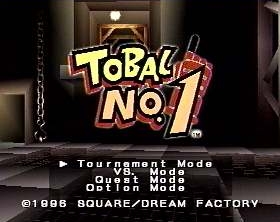 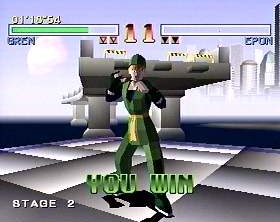 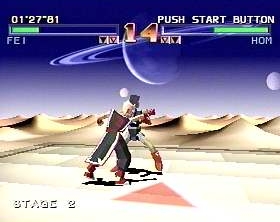 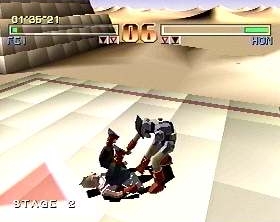 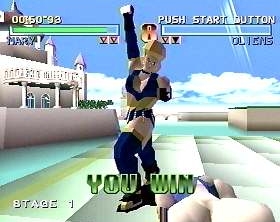 |
Please login to submit a screenshot
| Your Reviews |
|---|
 (Anonymous) (Playstation review) 23rd Apr 2012 05:31
"Soul Calibur, who’s your grandaddy?"
That’s right. Tobal’s your grandaddy. Square birthed the three-dimensional fighter in 1996 with their release of the blocky, yet breathtaking, fighting game. Critics acclaimed the innovative takes on a tired genre, hoping it would promote a revival. They were overjoyed by the Quest Mode, which got the ball rolling for Tekken 3’s Ball Mode and Soul Calibur’s Mission Mode years later. And gamers loved it for the Final Fantasy VII demo. Square was afraid that no one actually played the game, that they only played the demo, so America was robbed of a sequel that many consider to be the greatest fighting game ever developed.
Until Square gets themselves a fighting compilation disc to go with their Final Fantasy anthologies and collections, we’ll be stuck with the first edition. And if you can get past the blocky graphics, it’s a doozy. Every single aspect that you take for granted in a modern three-dimensional fighter is found here. Movement is not limited to horizontal directions only, but instead you’re free to chase your opponent around the arena, circle them looking for an opening, and dodge a devastating kick by moving slightly to the left. Street Fighter couldn’t touch this -- the wave of the future had arrived, containing everything from throws and grapples to ring-outs.
Experienced Tobal players can find their bouts turning into mini-wrestling matches, as much of the time will be spent trying to execute powerful throws, and attempting to break out of your opponents. As it takes a character a little while to start a throw, if you press an attack button fast enough, your character can break free of the overall throwing attack, and end up with only minor damage. Even better, you can sometimes completely reverse the throw into one of your own or into a counterattack -- an uppercut to the jaw or a sweeping kick of the ankles.
Ring-Outs also added a new dimension to fighting games. Now, when your opponent’s health bar was still full and you were nearly finished off, you still had some hope. You just had to lure them to the edge of the stage, and connect with one solid punch or kick, and off they’d fly. Players who often found themselves ahead of their opponents had to be wary of this, and think of ways to finish them off without succumbing to their treachery.
Blocky, blatantly polygonal characters are a staple of games in the PlayStation’s early life span, and Tobal is no exception. Characters look to be made up of at about fifty polygons a piece -- certainly a small number when you think of that game characters today are constructed of thousands upon thousands of polygons. But this was par for the era, so it’s really not that big of a deal. Anyway, this certainly gives Tobal a dated look, and the minor polygon testing doesn’t help a whole lot.
I don’t know if the polygons are to blame for the slightly sluggish animation, but we had better blame something. Along with the slightly sluggish controls, the animation gives the game a very sloth-like look and feel. Characters move as if they are always tired, and are in desperate need of a nap to function normally.
Despite the graphical flaws, Tobal’s artists have done some things very well. First off, the opening cut scene is one of the more impressive graphical effects from the first two years of the PlayStation’s existence, and it establishes SquareSoft’s dominance as creator of top-of-the-line FMVs a year before the release of Final Fantasy VII. The coloring of the characters is also quite impressive, providing a realistic, yet whimsical shading for the combatants. Without the coloring you would not get the feel of being on another planet, where this tournament is held.
The most impressive graphical effect is that of the arenas and environments. At first glance in a match, you’ll see a tiled floor on which you’re duking it out -- no big deal. If you begin to look around, however, you’ll see detailed cities in far off in the distance. On some stages castles outlaid in jewels and precious metals are seen among the clouds. These images seem to have been completed in watercolors, so they have a very soft look to them, and it really makes Tobal a lot more atmospheric. However, the clash among styles can be rather jarring, and at times these painted, fantastic buildings seem out of place among the futuristic character designs and banal arenas themselves.
Musically, Tobal’s soundtrack is akin to that of Wipeout, only without licensed bands like Prodigy. It has a hard-driving rock/techno play list, with tempos that range from Sarah McLachlan to Rage Against the Machine. An eclectic mix indeed. Each song has been paired up with a stage that fits it perfectly. The grittier stages will have harder, faster songs, while the more whimsical ones will have the floatier tunes that focus much more on keyboard play.
The sound effects in Tobal are pretty typical for the genre, and none of the noises really stand out. Since it is a realistic fighting game (as opposed to Street Fighter, with its fantasy-setting fire blasts and such) you will not hear sound effects that you wouldn’t hear in a martial arts tournament. That being said, the level of realism doesn’t approach that of a Virtua Fighter, but the realism in the sound effects do. You will hear a few snippets of voice acting, all in Japanese, as well as noises for the connection of punches and kicks, along with the obligatory grunts. What would a fighting game be without male characters grunting and the female characters shrieking in pain? Nothing! Nothing, I tell you!
As I mentioned before, Tobal is a bit sluggish to control. Characters do not move very fast, and forces battles become very defensive. It’s very hard to go on the offensive when your character can’t move fast enough to connect a whole lot of punches. Another problem with the control is the configuration. In most three-button interfaces on the PlayStation, ‘X’ is the button that doesn’t have an attack lined-up with it. In Tobal, that button is ‘O,’ which really can throw you off after playing other fighting games and turning to this one, no matter how great it is.
The Quest Mode in Tobal is one of the most critically acclaimed additions to any fighting game in recent memory -- It’s great fun to play! You can progress through dungeons with a character of your choice in a beat-’em-up style romp. Dungeons are filled with puzzles, normal foes, and huge bosses that will take both strength and savvy to fell. Dungeons are basically mazes, beneath ground, and with multiple floors. To put it in a more modern perspective, the early temples from Final Fantasy X were obviously modeled after these stages that Square had already perfected years before.
Even as a classic fighting game, Tobal retains plenty of interest. Versus Mode, Tournament Mode, and a Practice Mode are all present, for you to hone your skills against friends, the computer, and yourself respectively. Using the innovative battle system, you are certainly going to find enough bang for your buck between the Quest Mode and these three modes that are standard on all tournament fighting games.
Tobal has an interesting quirk in its Tournament Mode -- difficulty does not seem to rise as you progress. Instead, some foes seem to be more naturally difficult than others. Fei, Hom, and Udan himself are more challenging battles than the others, regardless of where you face them in the order. Quest Mode has a much more natural progression, with each subsequent floor becoming harder than the one above it.
Fighting games are made to be played and played again, and Tobal is no exception. Quest Mode will take hours of your life away, and Versus Mode can go into heavy rotation in fighting game tournaments. (It and Tekken 3 are the only reasons that the PlayStation is even included in it at all.) With hidden characters to unlock the further you progress, there are plenty of reasons for you to replay Tobal time and time again.
Tobal has that Zone of the Enders quality to it; More people bought it for the demo included than for the game itself. And since I bought Tobal in 2001 -- years after I beat Final Fantasy VII -- I can truly accept the game for what it is. I haven’t touched the much ballyhooed demo to date, and to me, Tobal will not be a game packaged in with the future. Instead, Tobal will be the game that brought about the future in other aspects entirely.
PROS
*Introduced the world to a well-done three-dimensional fighting game.
*Wonderful looking environments.
*Very fitting, motivating soundtrack.
CONS
*Extremely blocky characters.
*Controls are a bit sluggish.
*Quest Mode character upgrades do not translate into other modes.
SCORE SUMMARY
GAMEPLAY--9
GRAPHICS--6
MUSIC--9
SOUND--7
CONTROL--4
FUN--8
CHALLENGE--MEDIUM
REPLAY VALUE--MEDIUM TO HIGH
OVERALL--8
Reviewer's Score: 8/10, Originally Posted: 07/12/02, Updated 07/12/02
That’s right. Tobal’s your grandaddy. Square birthed the three-dimensional fighter in 1996 with their release of the blocky, yet breathtaking, fighting game. Critics acclaimed the innovative takes on a tired genre, hoping it would promote a revival. They were overjoyed by the Quest Mode, which got the ball rolling for Tekken 3’s Ball Mode and Soul Calibur’s Mission Mode years later. And gamers loved it for the Final Fantasy VII demo. Square was afraid that no one actually played the game, that they only played the demo, so America was robbed of a sequel that many consider to be the greatest fighting game ever developed.
Until Square gets themselves a fighting compilation disc to go with their Final Fantasy anthologies and collections, we’ll be stuck with the first edition. And if you can get past the blocky graphics, it’s a doozy. Every single aspect that you take for granted in a modern three-dimensional fighter is found here. Movement is not limited to horizontal directions only, but instead you’re free to chase your opponent around the arena, circle them looking for an opening, and dodge a devastating kick by moving slightly to the left. Street Fighter couldn’t touch this -- the wave of the future had arrived, containing everything from throws and grapples to ring-outs.
Experienced Tobal players can find their bouts turning into mini-wrestling matches, as much of the time will be spent trying to execute powerful throws, and attempting to break out of your opponents. As it takes a character a little while to start a throw, if you press an attack button fast enough, your character can break free of the overall throwing attack, and end up with only minor damage. Even better, you can sometimes completely reverse the throw into one of your own or into a counterattack -- an uppercut to the jaw or a sweeping kick of the ankles.
Ring-Outs also added a new dimension to fighting games. Now, when your opponent’s health bar was still full and you were nearly finished off, you still had some hope. You just had to lure them to the edge of the stage, and connect with one solid punch or kick, and off they’d fly. Players who often found themselves ahead of their opponents had to be wary of this, and think of ways to finish them off without succumbing to their treachery.
Blocky, blatantly polygonal characters are a staple of games in the PlayStation’s early life span, and Tobal is no exception. Characters look to be made up of at about fifty polygons a piece -- certainly a small number when you think of that game characters today are constructed of thousands upon thousands of polygons. But this was par for the era, so it’s really not that big of a deal. Anyway, this certainly gives Tobal a dated look, and the minor polygon testing doesn’t help a whole lot.
I don’t know if the polygons are to blame for the slightly sluggish animation, but we had better blame something. Along with the slightly sluggish controls, the animation gives the game a very sloth-like look and feel. Characters move as if they are always tired, and are in desperate need of a nap to function normally.
Despite the graphical flaws, Tobal’s artists have done some things very well. First off, the opening cut scene is one of the more impressive graphical effects from the first two years of the PlayStation’s existence, and it establishes SquareSoft’s dominance as creator of top-of-the-line FMVs a year before the release of Final Fantasy VII. The coloring of the characters is also quite impressive, providing a realistic, yet whimsical shading for the combatants. Without the coloring you would not get the feel of being on another planet, where this tournament is held.
The most impressive graphical effect is that of the arenas and environments. At first glance in a match, you’ll see a tiled floor on which you’re duking it out -- no big deal. If you begin to look around, however, you’ll see detailed cities in far off in the distance. On some stages castles outlaid in jewels and precious metals are seen among the clouds. These images seem to have been completed in watercolors, so they have a very soft look to them, and it really makes Tobal a lot more atmospheric. However, the clash among styles can be rather jarring, and at times these painted, fantastic buildings seem out of place among the futuristic character designs and banal arenas themselves.
Musically, Tobal’s soundtrack is akin to that of Wipeout, only without licensed bands like Prodigy. It has a hard-driving rock/techno play list, with tempos that range from Sarah McLachlan to Rage Against the Machine. An eclectic mix indeed. Each song has been paired up with a stage that fits it perfectly. The grittier stages will have harder, faster songs, while the more whimsical ones will have the floatier tunes that focus much more on keyboard play.
The sound effects in Tobal are pretty typical for the genre, and none of the noises really stand out. Since it is a realistic fighting game (as opposed to Street Fighter, with its fantasy-setting fire blasts and such) you will not hear sound effects that you wouldn’t hear in a martial arts tournament. That being said, the level of realism doesn’t approach that of a Virtua Fighter, but the realism in the sound effects do. You will hear a few snippets of voice acting, all in Japanese, as well as noises for the connection of punches and kicks, along with the obligatory grunts. What would a fighting game be without male characters grunting and the female characters shrieking in pain? Nothing! Nothing, I tell you!
As I mentioned before, Tobal is a bit sluggish to control. Characters do not move very fast, and forces battles become very defensive. It’s very hard to go on the offensive when your character can’t move fast enough to connect a whole lot of punches. Another problem with the control is the configuration. In most three-button interfaces on the PlayStation, ‘X’ is the button that doesn’t have an attack lined-up with it. In Tobal, that button is ‘O,’ which really can throw you off after playing other fighting games and turning to this one, no matter how great it is.
The Quest Mode in Tobal is one of the most critically acclaimed additions to any fighting game in recent memory -- It’s great fun to play! You can progress through dungeons with a character of your choice in a beat-’em-up style romp. Dungeons are filled with puzzles, normal foes, and huge bosses that will take both strength and savvy to fell. Dungeons are basically mazes, beneath ground, and with multiple floors. To put it in a more modern perspective, the early temples from Final Fantasy X were obviously modeled after these stages that Square had already perfected years before.
Even as a classic fighting game, Tobal retains plenty of interest. Versus Mode, Tournament Mode, and a Practice Mode are all present, for you to hone your skills against friends, the computer, and yourself respectively. Using the innovative battle system, you are certainly going to find enough bang for your buck between the Quest Mode and these three modes that are standard on all tournament fighting games.
Tobal has an interesting quirk in its Tournament Mode -- difficulty does not seem to rise as you progress. Instead, some foes seem to be more naturally difficult than others. Fei, Hom, and Udan himself are more challenging battles than the others, regardless of where you face them in the order. Quest Mode has a much more natural progression, with each subsequent floor becoming harder than the one above it.
Fighting games are made to be played and played again, and Tobal is no exception. Quest Mode will take hours of your life away, and Versus Mode can go into heavy rotation in fighting game tournaments. (It and Tekken 3 are the only reasons that the PlayStation is even included in it at all.) With hidden characters to unlock the further you progress, there are plenty of reasons for you to replay Tobal time and time again.
Tobal has that Zone of the Enders quality to it; More people bought it for the demo included than for the game itself. And since I bought Tobal in 2001 -- years after I beat Final Fantasy VII -- I can truly accept the game for what it is. I haven’t touched the much ballyhooed demo to date, and to me, Tobal will not be a game packaged in with the future. Instead, Tobal will be the game that brought about the future in other aspects entirely.
PROS
*Introduced the world to a well-done three-dimensional fighting game.
*Wonderful looking environments.
*Very fitting, motivating soundtrack.
CONS
*Extremely blocky characters.
*Controls are a bit sluggish.
*Quest Mode character upgrades do not translate into other modes.
SCORE SUMMARY
GAMEPLAY--9
GRAPHICS--6
MUSIC--9
SOUND--7
CONTROL--4
FUN--8
CHALLENGE--MEDIUM
REPLAY VALUE--MEDIUM TO HIGH
OVERALL--8
Reviewer's Score: 8/10, Originally Posted: 07/12/02, Updated 07/12/02
| Cheats | Trivia |
|---|---|
| There are no cheats on file for this title. | No trivia on file for this title. |
History
This title was first added on 6th November 2005
This title was most recently updated on 23rd April 2012